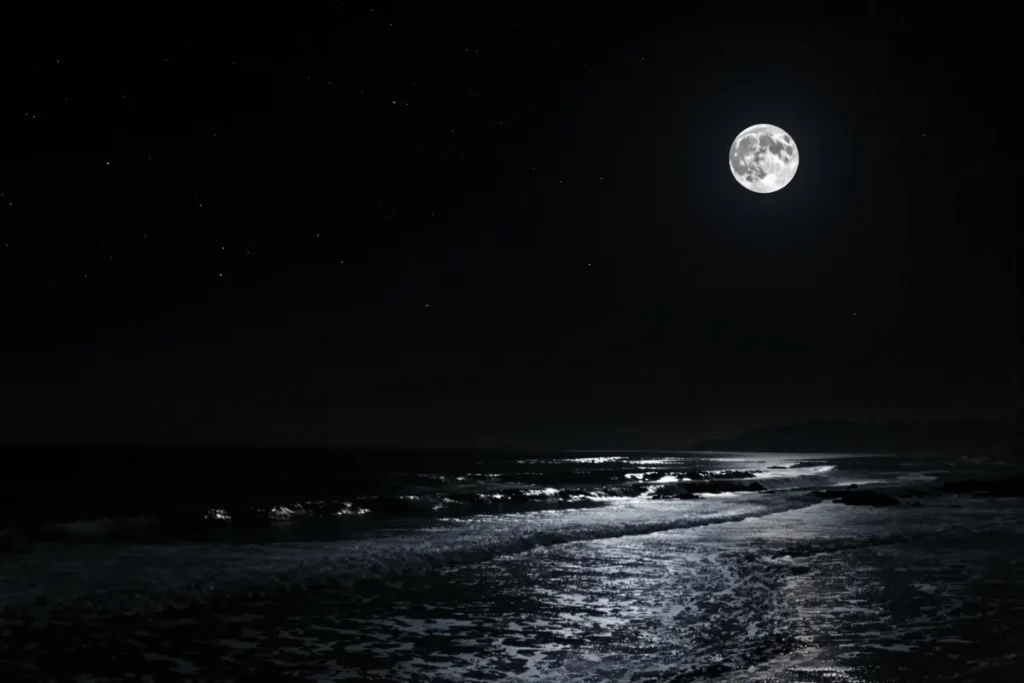
The Moon might seem steady, guiding the tides and lighting up our night skies. But right now, it’s quietly slipping away from Earth. Every year, it drifts a little farther into space — and that tiny adjustment is already changing the length of our days and reshaping the tides. The movement is almost invisible, but the effects are written deep in Earth’s past and point toward a very different future.
Why the Moon is drifting away
It all starts with gravity and tides. The Moon pulls on Earth’s oceans, creating two bulges: one facing the Moon and one on the opposite side. But Earth spins faster than the Moon orbits us. That means the tidal bulges are always slightly ahead of the Moon in its orbit.
This matters. Those bulges aren’t just piles of water — they tug on the Moon, giving it energy. That causes the Moon to climb into a slightly higher orbit.
- The Moon drifts away at about 3.8 centimeters per year — roughly the growth speed of your fingernails.
- As the Moon gains energy, Earth loses just a bit of its rotational speed.
- This causes our days to slowly lengthen, though the change is just milliseconds per century.
How we know it’s happening
You might be wondering — how do scientists measure something so small from so far away? The answer begins with lasers and Apollo missions.
Apollo astronauts left retroreflectors—basically special mirrors—on the Moon’s surface. Scientists shoot lasers from Earth toward these mirrors. Then, they time how long it takes for the light to bounce back.
- This method is accurate down to millimeters.
- Over decades of measurements, the slow drift becomes clear.
So, it’s not a guess. It’s a measured change, recorded over generations of observations.
What the Moon’s past tells us about ancient Earth
Fossils reveal that this drift has been happening for a long, long time. In fact, 70 million years ago during the late Cretaceous period, a day on Earth was only about 23.5 hours long.
The evidence lies in ancient marine shells. Some creatures like the clam-like Torreites sanchezi formed microscopic daily growth layers in their shells. By counting these, scientists found there were about 372 days in a year back then — proof that each day was shorter because Earth spun faster.
Go even further back, and days were even shorter. When the Moon first formed — likely from a massive collision 4.5 billion years ago — Earth may have spun so fast that a single day lasted just 6 to 12 hours. That period saw enormous tides and rapid rotation shaping young planetary conditions.
What this means for Earth’s future
As the Moon continues its slow escape, a few things are already changing. Others might shift far into the future — if our planet lasts long enough.
Total eclipses will become rare
The more distant the Moon, the smaller it looks in the sky. Over millions of years, total solar eclipses will become impossible. Instead, we’ll get brighter “annular” eclipses, where the Sun appears as a ring around the Moon.
Tides will lose their power
We’ll still have tides, but they’ll be weaker and less energetic. That could impact coastal ecosystems that depend on the ebb and flow of water. Storm surges and local geography will still make a splash, but globally things may grow much calmer.
Days will keep stretching
If this cosmic balancing act continued untouched, we could reach a point called tidal locking. That means Earth would spin once for every Moon orbit — one full day would last about 27 of our current days.
In that future, one side of Earth would always face the Moon. Tides would freeze into permanent bulges. But there’s a catch — it likely won’t get that far.
The Sun will decide our fate first
In about a billion years, the Sun will grow brighter and start boiling away Earth’s oceans. Without sloshing seas, the Moon’s retreat will slow down or stop completely. Eventually, the Sun will expand into a red giant, possibly swallowing both Earth and Moon altogether.
What we’re learning from ancient tides
Rock layers and ocean sediments preserve more than fossils — they capture rhythms of ancient tides and Earth’s rotation. Scientists use these natural records to reconstruct how the planet’s climate, ocean chemistry, and day lengths changed over time.
| Epoch | Approximate Day Length | Estimated Year Length |
|---|---|---|
| Modern Earth | 24 hours | 365 days |
| Late Cretaceous | ~23.5 hours | ~372 days |
| Early Earth | ~6–12 hours | More than 365 days |
With tools from satellites to ancient rocks, researchers connect the dots between deep time and the present day. They even apply what they learn here to the study of exoplanets. Planets with big moons might be more stable, more habitable — and may have climates shaped by tidal effects, just like Earth.
The takeaway: change is constant
Next time you’re watching the tide roll in, or stepping into the shadow of a solar eclipse, remember you’re standing in a world that’s slowly shifting. The Moon’s quiet drift is stretching our days and softening our tides. It’s a change you won’t feel directly — but one that echoes through Earth’s rhythms, from climate patterns to life on the shore. And one day far ahead, future skies and coastlines might look very different from the ones we see today.